A Polish TETRA network, on air.
TETRA Poland is a community of radio amateurs that built its own digital TETRA network — base stations, TetraSpot hotspots and an app for your phone. Group calls, SDS, GPS location and a terminal map in real time. Open to everyone, wherever you live.
Everything digital TETRA gives you.
Not an emulation and not a toy — a full digital TETRA trunked network on the 70 cm amateur band. These features run live, between real Motorola, Sepura and Hytera radios.
PTT group calls
Push-To-Talk conversations in talkgroups with floor control and late entry. One transmits, the whole group hears — locally and across the network.
Individual calls
Terminal to terminal, half-duplex (simplex PTT) and full-duplex. The full setup / alert / connect / release flow, as in commercial TETRA.
SDS messages
Short text messages and statuses between radios — local and routed between nodes through the network hub.
GPS / LIP location
Terminals report their position over LIP. We track them live on a map that refreshes every 30 seconds.
Encryption and keys
Optional terminal authentication and over-the-air distribution of encryption keys — operator-grade security in an amateur network.
Scanning and DGNA
Talkgroup scanning with priority and hold, plus dynamic group assignment — radios receive talkgroups over the air.
Telephony gateway
A SIP / PABX bridge connects the TETRA network to the telephone world — calls beyond the radio, in both directions.
Inter-node network
Stations tie into one network through the TetraPoland hub, with a TetraPack bridge to other TETRA networks.
Packet data
The radio gets an IP address and reaches the internet through the station. Voice comes first — a call always takes a slot back from data.
WAP portal on the radio
The radio’s browser opens pages served by the station: cell status, a call log with callsigns, the SDS log and the list of registered radios.
Second carrier
Dual carrier — two carriers from one station. More simultaneous calls, and the data channel gets a carrier of its own.
APRS bridge
Positions of the radios and of the station itself reach APRS maps, with a callsign mapped to each radio number.
Radios on air. A hub in the cloud.
The radio signal comes off the air into a station, and the stations and apps tie into one network through the hub. Out to the world — to BrandMeister — every client goes independently. Openly, transparently, on hardware we own.
Our own hardware.
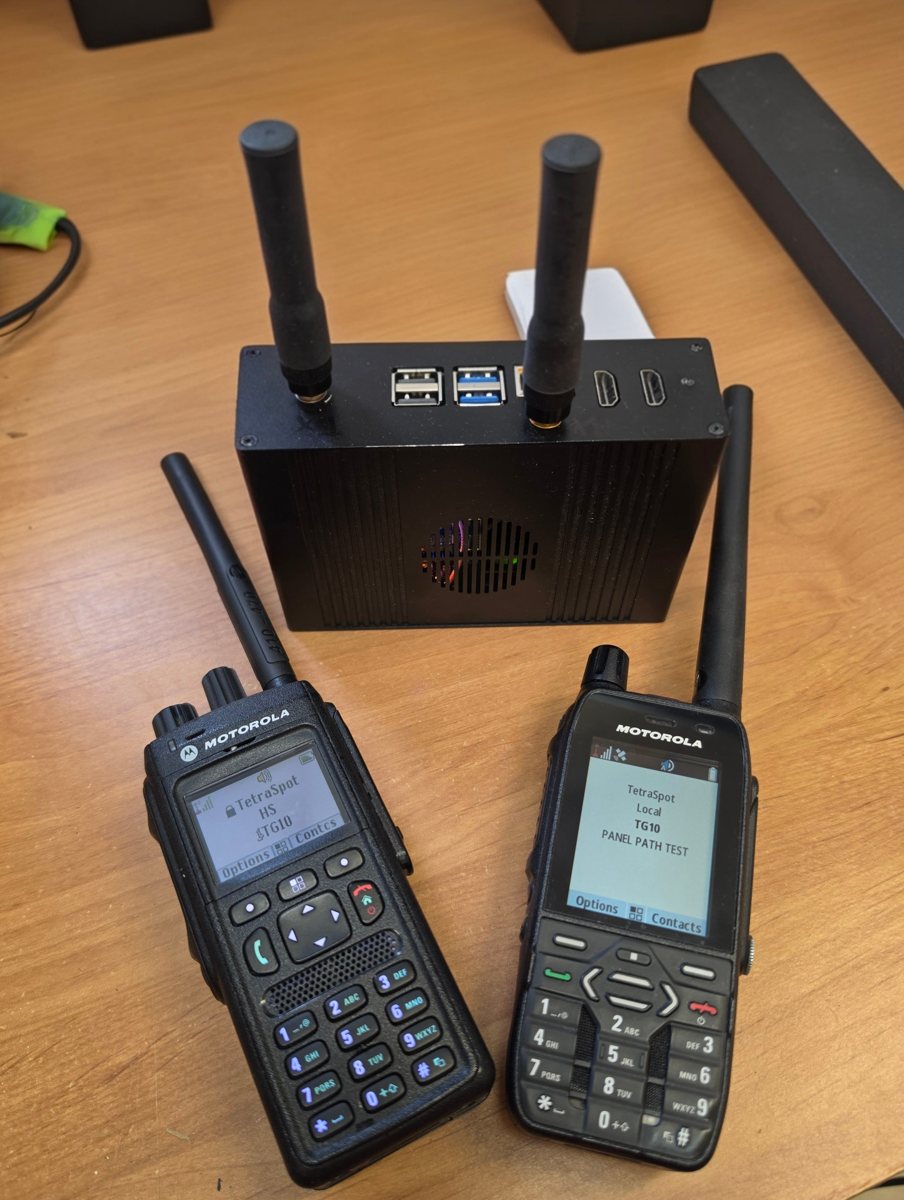
TetraSpot base stations and hotspots on a Raspberry Pi with an SDR radio. Five stations from Świdnik to Gdynia and Wrocław — with no hidden operator infrastructure behind them.
Built to ETSI.
An air interface compliant with EN 300 392-2. If a radio works on a real TETRA network, it works on ours — Motorola, Sepura, Hytera. Tested on, among others: Motorola MTH800, MTP700, MTP850, CEP400, MTP35xx, MXP600, the whole MTM/MXM range and the Hytera PTC760.
Built to run.
The network runs around the clock, with monitoring, a GPS map and a live dashboard. This is not a prototype for one demo — it is working communication.
- Routes voice and SDS between stations and apps
- A shared database of subscribers and talkgroups
- Admin console and a live view of the network
- TetraSpot base stations and hotspots — radios over the air
- TetraPoland apps for Android and iOS — over the internet
- Every client connects to the hub, and separately to the world
- Every TetraSpot and every app has its own, independent link
- No hub in between — nothing on the way can cut you off from the world
- Shared talkgroups with the global community
Every client connects to the TetraPoland hub — TetraSpot stations and the apps on Android and iOS — and that is where talkgroups 10–90 live. The way out to the world is each client’s own: an independent link to BrandMeister from talkgroup 91 upwards. What a commercial operator sells as a closed system, we build in the open, on hardware we own.
Real people. Real meetups.
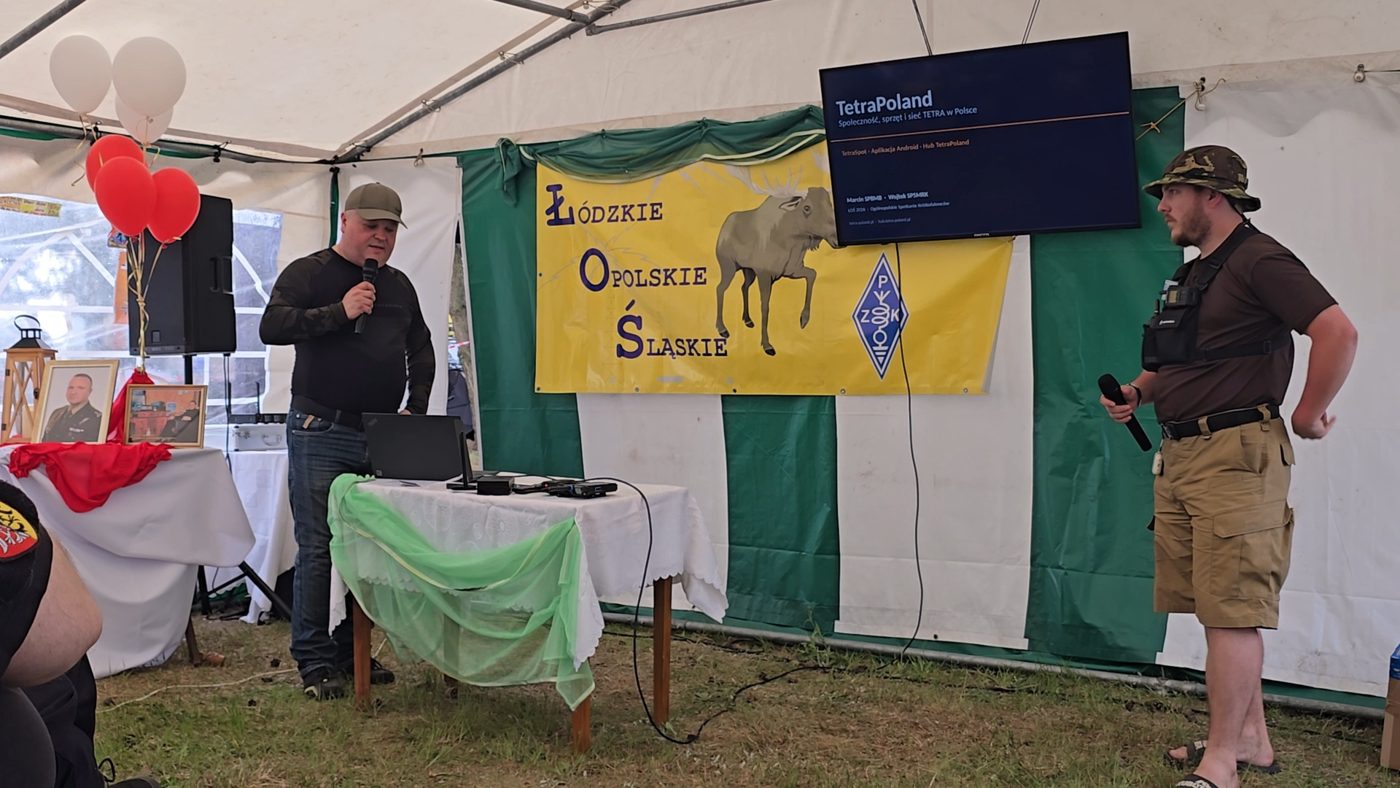
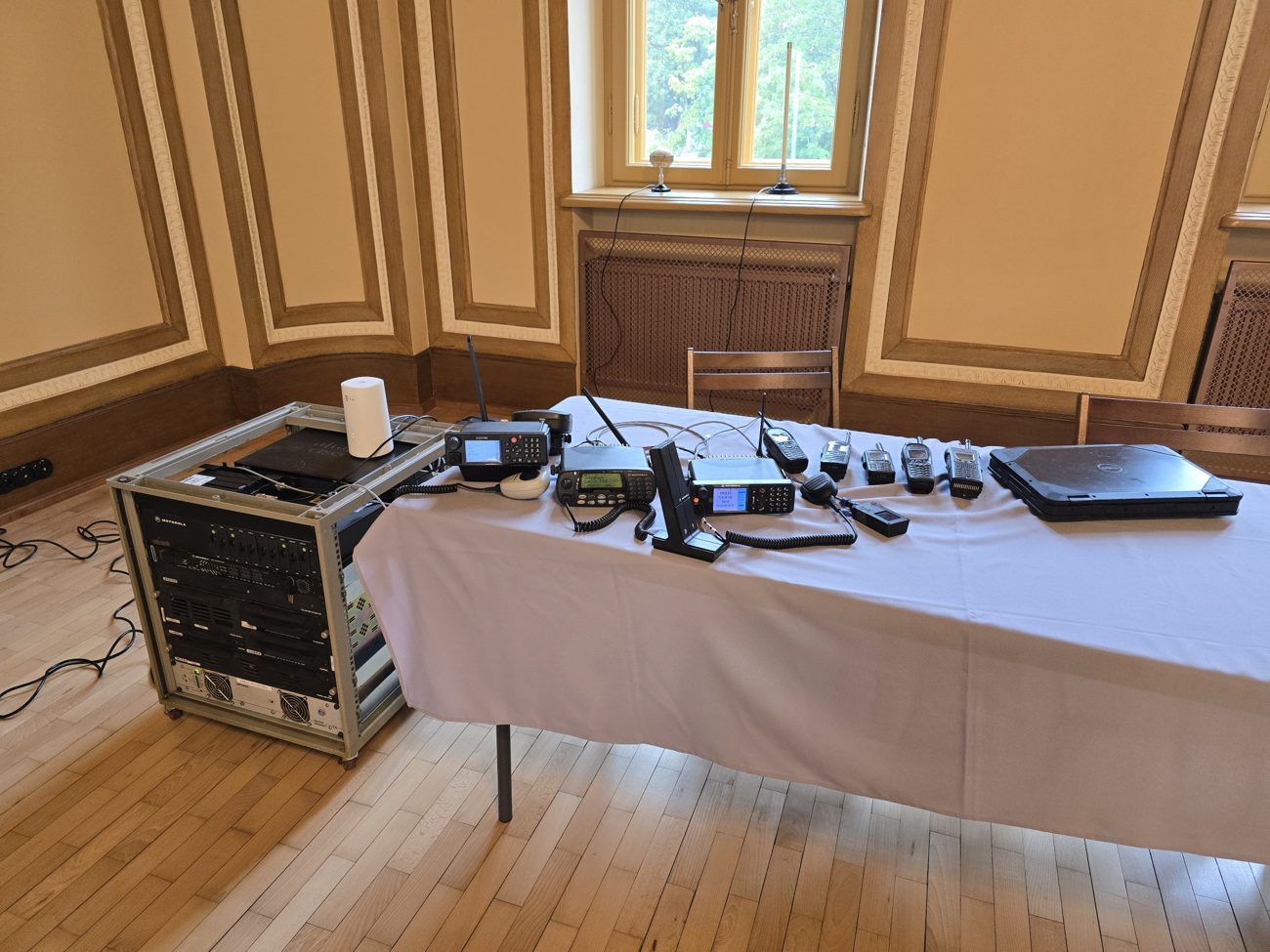
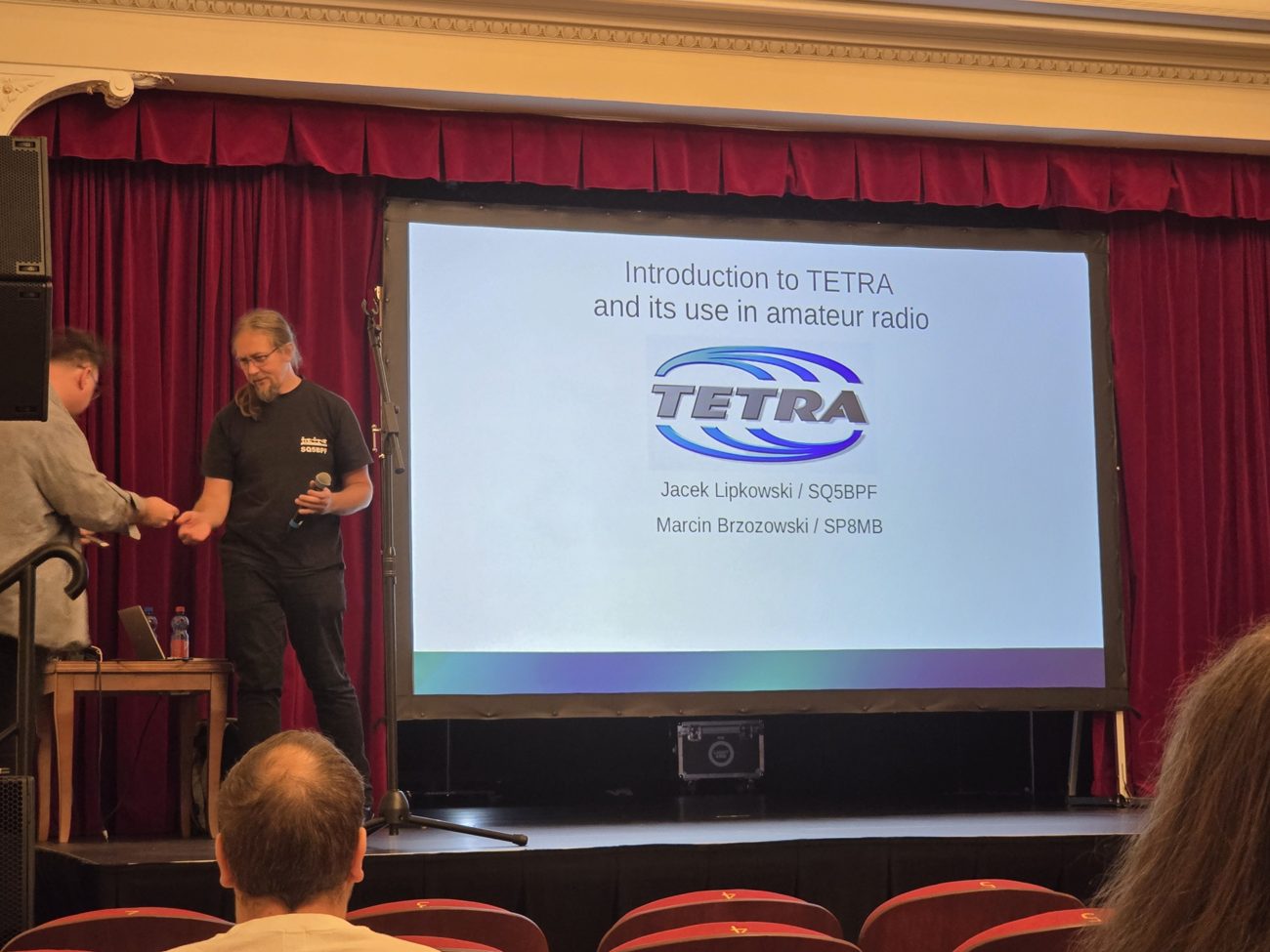
Behind TetraPoland stand radio amateurs from across Poland — we meet at rallies and conferences, show the hardware running and share what we learn. This is not a company looking for customers, it is a community.
From the sofa to your first TETRA QSO.
Getting into TETRA is cheaper than you think — all you need is a radio and the will. Three steps stand between you and your first call on the network.
Get a radio
A Motorola MTP3550 / MTH800 or a Hytera PT580 / PT790 — second-hand from about 400 zł on the usual auction sites.
Program the codeplug
Set the TetraPoland talkgroups in the 430–440 MHz band (Motorola CPS required). Network parameters: MCC 901 · MNC 9998, start frequency 440 MHz, shift 10 MHz — these are the defaults; on the TetraSpot side you can set them to anything.
Join the community
The Telegram group TETRA-POLAND ↗ and the Facebook group TETRAPoland ↗ are the fastest way to reach us, plus the hub map here on tetra-poland.pl. No coverage where you live? Build your own TetraSpot.
Watch the network in real time.
Everything happening on the TetraPoland network is visible live — calls, terminal positions and base station status. No login, straight from the browser.
GPS terminal map
TETRA terminal positions on a map in real time, GPS tracks, filtering by callsign and date range.
Open the map →Call dashboard
TETRA call statistics, an activity table and base station status — power, VSWR, PA temperature, UPS.
Open the dashboard →TetraPoland hub
The main inter-node hub dashboard — stations, subscribers and calls across the whole network, live.
hub.tetra-poland.pl ↗Fourteen projects. One obsession.
A whole ecosystem of open TETRA software and hardware grew around the network — from the base station to a SIM card applet. All of it developed inside the community.
TetraSpot
A TETRA base station (TETRA hotspot) with microservice architecture — voice, SDS, packet data with internet access, LIP, a SIP gateway and the hub. Two power variants, configured from a browser, with a full operating manual.
Details →Multi-Radio
A multi-system radio on a Raspberry Pi — nine systems, from FM through TETRA, DMR, P25, M17, D-STAR and YSF to NXDN and dPMR, in one device driven from a phone. It scans across systems and stops wherever someone is transmitting. The first SDR terminal in ham radio with hardware requirements this modest.
Details →SwMI for Motorola stations
A homebrew controller for the professional Motorola EBTS, MBTS and MTS base stations — the BR (Base Radio) works for us with the TSC (Site Controller) eliminated, and the station joins the TetraPoland network with the same stack as TetraSpot. Since September 2026 it has been running a real station, with two carriers in one cell checked on the air — with the whole package that comes with it.
Details →OSNOWA
An encrypted LoRa mesh network with no internet and no licence — end-to-end encryption, relays that hold no user keys, an interface with the TETRA network (SDS, statuses, LIP), remote control and encrypted telemetry; apps for Windows, Android, iOS and Linux.
Details →TLA — Tetra Light Analyzer
A web TETRA network analyzer on a Raspberry Pi: 64 channels, voice playback, FFT spectrum, SDS decoding.
Details →TetraPoland Android
A software TETRA terminal (PTT-over-Cellular) — a radio’s full functionality on your phone.
Details →TetraPoland iOS
The same TETRA terminal on iPhone and iPad — PTT and private calls, CallKit. Available through TestFlight.
Details →ATAK TETRA Plugin
TETRA radio integrated with the ATAK tactical map — LIP positions as CoT, SDS and PTT from the map.
Details →TSIM — SIM Applet
A JavaCard applet for the TETRA identity module (TIM/TSIM) — full TAA1 and encryption key management.
Details →TETRA Remote Head
A remote control head for Motorola radios over PEI — full-duplex WebRTC audio from a browser.
Details →OWRX Mobile
A native OpenWebRX+ client for Android — background audio, band scanner, TETRA monitor and an APRS map.
Details →OpenWebRX+ TETRA Plugin
A TETRA decoder for OpenWebRX+ — π/4-DQPSK demodulation, ACELP speech and a live network panel in the browser.
Details →TETRA Air Trace
A TETRA signalling decoder over the PEI of a Motorola radio — 30+ frame types, on Windows, Android and desktop.
Details →Spectrum and EMC analyzer
A service spectrum analyzer with a TETRA decoder (TMO/DMO, ACELP voice), measurements and EMC testing. Drives a cheap SDR or a Rigol analyzer.
Details →What is TETRA radio?
TETRA (Terrestrial Trunked Radio) is a digital trunked radio standard developed by ETSI. It is used by emergency services, police, fire brigades, ambulance services, public transport, airports, ports, the military and industry worldwide. In Poland, TETRA is the backbone of the national radio system for public services.
The standard offers encrypted group calls (PTT — Push To Talk), individual calls (half/full-duplex), SDS text messages, GPS location reporting over the LIP protocol, packet data (SNDCP) and advanced security mechanisms — TAA1 authentication, optional encryption and key management.
TETRA Poland is a community of radio amateurs and hobbyists developing this technology in an amateur setting — our own TetraSpot (TETRA hotspot) base station, the TLA signal decoder on a Raspberry Pi, the TetraPoland app for Android and iPhone, a plugin for ATAK, the TSIM SIM card applet and TETRA Remote Head for a remote Motorola control head. The project is led by Marcin Brzozowski (SP8MB).
Frequently asked questions.
What is TETRA?
TETRA (Terrestrial Trunked Radio) is a digital trunked radio standard developed by ETSI. It is used by emergency services, police, public transport and industry — offering encrypted group PTT calls, individual calls, SDS text messages, GPS location reporting (LIP) and packet data transmission.
How does TETRA differ from DMR?
TETRA and DMR are both digital trunked radio standards. TETRA uses π/4-DQPSK modulation and 4 time slots on a 25 kHz channel, offers native trunking, optional end-to-end encryption, encryption-key management and more advanced network features. DMR is cheaper, simpler (2 slots, 12.5 kHz channel) and more popular among hobbyists and in local systems.
What is TetraSpot (TETRA hotspot)?
TetraSpot, also known as TETRA hotspot, is a full implementation of the TETRA protocol stack — a base station (BS) with microservice architecture. It supports group and individual voice calls (our own ACELP codec implementation per the ETSI specification), SDS messages, packet data (the radio gets an IP address and reaches the internet) with a WAP portal on the handset, GPS/LIP location, optional terminal authentication, key management, SIP/PABX gateway and integration with the TetraPoland hub. It runs on one or two carriers (dual carrier). Deployed on Raspberry Pi 5 with SDR radio (USRP, LimeSDR, sxceiver).
Can I use TETRA without a license?
Commercial TETRA bands (380–400 MHz for emergency services, 410–430 MHz, 450–470 MHz) require a license from the national regulator. For amateur radio operators, experimentation is possible on the 70 cm amateur band (430–440 MHz) under a valid receive or transmit license. TETRA Poland runs an experimental base station in the 70 cm band.
How does the TETRA GPS terminal map work?
TETRA terminals send their GPS position via the LIP protocol (Location Information Protocol) to the base station. The map on tetra-poland.pl shows real-time terminal positions and GPS tracks with 30-second refresh. You can filter by terminal ID (ITSI) and date range. Reference point: SR8LST base station in Świdnik, Poland.
Who is behind TETRA Poland?
TETRA Poland is an initiative of the Polish community of TETRA amateurs and hobbyists, led by SP8MB. We develop our own TETRA base station, a signal decoder (TLA), mobile apps (TetraPoland for Android and iOS, ATAK plugin) and integrations with other radio systems.
Is the TetraPoland network only for Poles?
No. The domain is Polish because that is where the project started, but the network is open to everyone — nationality, country and language make no difference here. Stations and operators from outside Poland join on exactly the same terms. If you need extra talkgroups beyond the ones already running — for another country, a region or a group of operators — just ask on the TETRA-POLAND Telegram group (https://t.me/tetrapoland) or by e-mail at marcin@sp8mb.pl, and they will be created.
Get on the TetraPoland network.
Have a TETRA radio, or want to build your own TetraSpot? Join the community building an open, digital radio network on the 70 cm band — wherever in the world you are.
Direct contact: marcin@sp8mb.pl