Fifteen projects built by the Polish ham radio community — from a base station and SDR receivers, through mobile apps, to a SIM card applet. All hand-built, on open hardware.
📡
TetraSpot — TETRA hotspot
TETRA stack — base station (TETRA hotspot) with microservice architecture
Online
TetraSpot is an implementation of the TETRA protocol stack. The project enables running a TETRA base station with support for voice calls (group, individual simplex and full-duplex), SDS messages, packet data with internet access, GPS location (LIP) and integration with external networks (TetraPack via the TetraPoland hub, SIP/PABX). The microservice-based architecture allows flexible deployment — from a single Raspberry Pi 5 to multi-site configurations.
Features
Full BS radio stack: PHY → LMAC → UMAC → LLC → MLE → MM/CMCE/SNDCP
SYNC/SYSINFO broadcast — network visible as a valid TETRA network
Terminal registration (MM Location Update) and group attachment
Group voice calls — our own ACELP codec implementation per the ETSI specification
Individual P2P calls (half-duplex and full-duplex)
Floor control for half-duplex calls
SDS messages — individual and group, send, receive, store & forward
Private-call relay between apps — the hub brokers the call setup
GPS/LIP location — terminal position tracking
Packet data — the radio gets an IP address and reaches the internet through the station
WAP portal on the radio — the handset’s own browser opens pages served by the station: cell status, call log with callsigns, SDS log and the list of attached radios
Voice takes precedence over data — a call reclaims the packet-data timeslot, and a dormant radio is woken when data arrives for it
Dual carrier — more simultaneous calls from one station, with the data channel on its own carrier
APRS bridge — radio and station positions reach APRS maps, with callsigns mapped to radio numbers
Optional TEA1 authentication with whitelist
OTAR key distribution (Over-The-Air Rekeying) — SCK/CCK/GCK
Dynamic group assignment (DGNA)
Sign in to the network with BrandMeister credentials
Integration with TetraPack via the TetraPoland hub
TetraPoland hub: floor arbitration, dashboard accounts, event log and live updates
TetraPoland apps for Android and iOS recognized in the hub — with each client’s version
Hub admin console: talk straight from the browser onto the air, listen in on a chosen source (group, station or app), record calls and ban stations
Remote station control over SDS — a status or a text message (restart, reboot, power off), with delivery acknowledgement
Echo (parrot) service — call in and hear yourself, to check network access and audio quality
SIP/PABX telephony gateway
GSM cellular gateway — an SMS from the mobile network reaches the radio as SDS and back
Web management panel (dashboard, call logs, configuration) over HTTPS
Panel: timeslot occupancy view, power telemetry, transmit-path calibration and system logs straight from the browser
Radio codeplug management from the panel — read and write over USB, offline .cpe handling (no CPS, no Windows)
Optional supplementary services: a talking clock and street-name display on the radio (from its GPS position)
DMR ID database with callsign lookup
Ready-made SD card image — the station is personalized from a questionnaire (callsign, frequencies, talkgroups) and works after the first boot
Online wizard that issues the image — invite code, generation queue and automatic enrolment of the station into the network
Automatic fleet updates — every release is digitally signed and a station rejects an update without a valid signature
The talker’s name on the radio’s display during a group call — checked with Motorola MXP600 and MTP radios
Priorities and pre-emption — a private call can interrupt the group call its callee is sitting in, and a busy callee gives the caller a “called party busy” signal instead of a lost call
Radio position on demand (LIP) — the station asks the radio where it is and the answer lands on the map
Audio stream to a talkgroup — an optional module that plays a broadcast from an internet address to a chosen talkgroup, with priority
Encryption key management from the hub for the whole fleet of stations, including staged rotation of group keys without interrupting service — checked on the air
Hub: its own app accounts independent of BrandMeister, invitation codes for clients from outside the network, and binding each station to its own board — an SD card copied to another computer is rejected
Panel: CPU temperature and load charts for a day, two days and a week, a full English version, separate client and technician profiles, SDR receiver calibrations as tiles
Codeplug read and write for the Motorola MTP6650 as well
Raspberry Pi 5 deployment with systemd services
In development
Roaming between stations with an ongoing call kept alive (call restore) — deployed on the hub, awaiting an on-air trial between two stationsETSI ISI gateway — linking stations to each other through the standard inter-system interfaceMultislot packet-data channelLLC retransmission — ready, off by default until measured
The first SDR terminal in ham radio with hardware requirements this modest
Alphasince March 2026
One device instead of several radios — Multi-Radio today works in nine systems: analogue FM (with AM and SSB), TETRA, DMR, P25, M17, D-STAR, YSF (System Fusion), plus NXDN and dPMR — the last two not yet verified against a commercial radio. The whole thing fits on a Raspberry Pi with a single SDR board. We have been building it since March 2026, and it is the first SDR terminal in the ham radio world with hardware requirements this modest: it registers with the network, authenticates, attaches to talkgroups, transmits and receives voice and exchanges messages — without a commercial radio costing thousands. Every mode is checked against real gear: DMR against an AnyTone, P25 against a Harris, YSF against a Yaesu, D-STAR against an ICOM, and TETRA against a Motorola EBTS and a TetraSpot. The radio can also cycle through the systems on its own and stop wherever someone is transmitting. You drive it from a phone app, from the browser or from the touch panel on the station itself, and all the credentials — ISSI, MCC/MNC and talkgroups — go in online. No programming cable, no vendor software, no codeplug procedure.
Operating modes — working today
Analogue FM — receive and transmit, narrowband and wideband
AM and SSB (LSB/USB) — new analogue modes alongside FM
TETRA TMO — terminal registered to the network, checked against a Motorola EBTS and a TetraSpot
TETRA DMO — live monitoring of direct-mode traffic
DMR — two-way voice, confirmed on air against an AnyTone AT-D878UVII Plus
P25 — two-way voice, confirmed on air against a Harris P7100
M17 — two-way voice between our own stations; not yet tested against a commercial radio
D-STAR — two-way voice, confirmed on air against an ICOM ID-51
YSF (System Fusion) — two-way voice, confirmed on air against a Yaesu FT-991A
NXDN — full voice path (transmit and receive); not yet verified against a commercial radio
dPMR — full voice path (transmit and receive); not yet verified against a commercial radio
Mode switching at the press of a button — the new system is ready in about a second
Scanning across systems — the radio cycles through the modes and stops wherever someone is transmitting
Applications
Voice
Group calls on a TETRA network
Individual (private) calls
Conversations in DMR, P25, M17, D-STAR and YSF — transmit and receive
Monitoring TETRA direct mode, outside infrastructure coverage
Analogue FM communication from the same device
Data
SDS text messages with delivery reports
GPS position reports (LIP) — tracking on the map
Status messages — canned reports at one button press
Callsign, short messages and GPS position on air in D-STAR
Where it fits
An affordable terminal where a commercial radio costs too much
A monitoring and test station while building out a network
Learning and experimenting — full insight into what happens on air
Nine systems from one device, instead of buying several radios
Already working in TETRA mode
Network registration and TAA1 authentication
Attaching to talkgroups
Group and individual calls — setup and release
Voice reception (our own ACELP codec implementation)
Live view of network parameters and received signal level
Login settings configured online — no cable, no codeplug
Already working in the digital modes
DMR: live reception — who is transmitting, to which talkgroup, on what frequency
DMR: voice transmission straight on air with a PTT button
DMR: your own ID, talkgroup, Color Code and power set from the app
P25: voice transmission and reception with the radio and talkgroup identifiers decoded
P25: your own NAC, talkgroup and transmitting identifier set from the app
M17: two-way voice with the callsign in every frame — checked between our own stations
D-STAR: two-way voice, callsign and short messages
YSF (System Fusion): two-way voice, confirmed against a real Yaesu radio
TETRA DMO: monitoring — who is transmitting, to whom, and on which network
NXDN and dPMR: voice transmits and receives on our own hardware — compatibility with a commercial radio still unconfirmed (no radio to test against)
Optional voice encryption in the digital modes (DMR and P25)
DMR: AES-256 and RC4 voice encryption — encrypted voice sent from Multi-Radio is decrypted by an AnyTone, checked on the air
Scanning across systems, stopping on activity — dwell time per mode is configurable
S-meter and receive/transmit indicators in every mode
Control — phone, browser, panel
Android app — full control of the radio from your phone
Pick the link to the phone: automatic, Bluetooth or Wi-Fi — the app keeps it alive in the background too, with the screen off
PTT, monitoring and a live view in every mode
Frequency, talkgroups and parameters changed without touching the station config
Cross-system scanning started from the app — with a view of the mode the radio stopped on
Web panel still available — the same features from a browser, audio included
Touch control head on the station — every mode and setting, without a phone or a computer
Bluetooth pairing opened deliberately and only briefly — nobody outside takes over the transmitter
Paired-phone management — device list and unpairing from either side
Battery (UPS) monitoring — charge level, charging state and power draw in the app
Remote restart and shutdown of the station from the app
In development
Verifying NXDN and dPMR against commercial radiosTransmission in TETRA direct mode (DMO)Voice transmission in TETRA network mode (TMO)TETRA mode (TMO): emergency alarm, priorities, restoring an interrupted call, ambience listening, immediate SDS, mutual authentication and optional air-interface encryption — implemented in September, awaiting on-air trialsDMR Tier III (trunking) — a complete base-station and terminal stack; the station transmits a control channel received on the air, a two-station test and a commercial-radio test are still aheadLive reception of encrypted DMR voicePacket data transmissionDMR through a repeater (time slots)Running several modes at once"Plecki" back-plate module — the whole Multi-Radio station on the back of a smartphone, with its own battery and a 2 W amplifier (architecture and parts list done, schematic and PCB next)
Hardware requirements
Raspberry Pi · SDR HAT — that is all it takes to have a nine-system terminal. The board handles one mode at a time, so you switch between systems at the press of a button.
SwMI — a homebrew core for Motorola EBTS, MBTS and MTS base stations
Professional TETRA base stations without the vendor’s core network — by SP8MB
Pre-alphasince February 2026
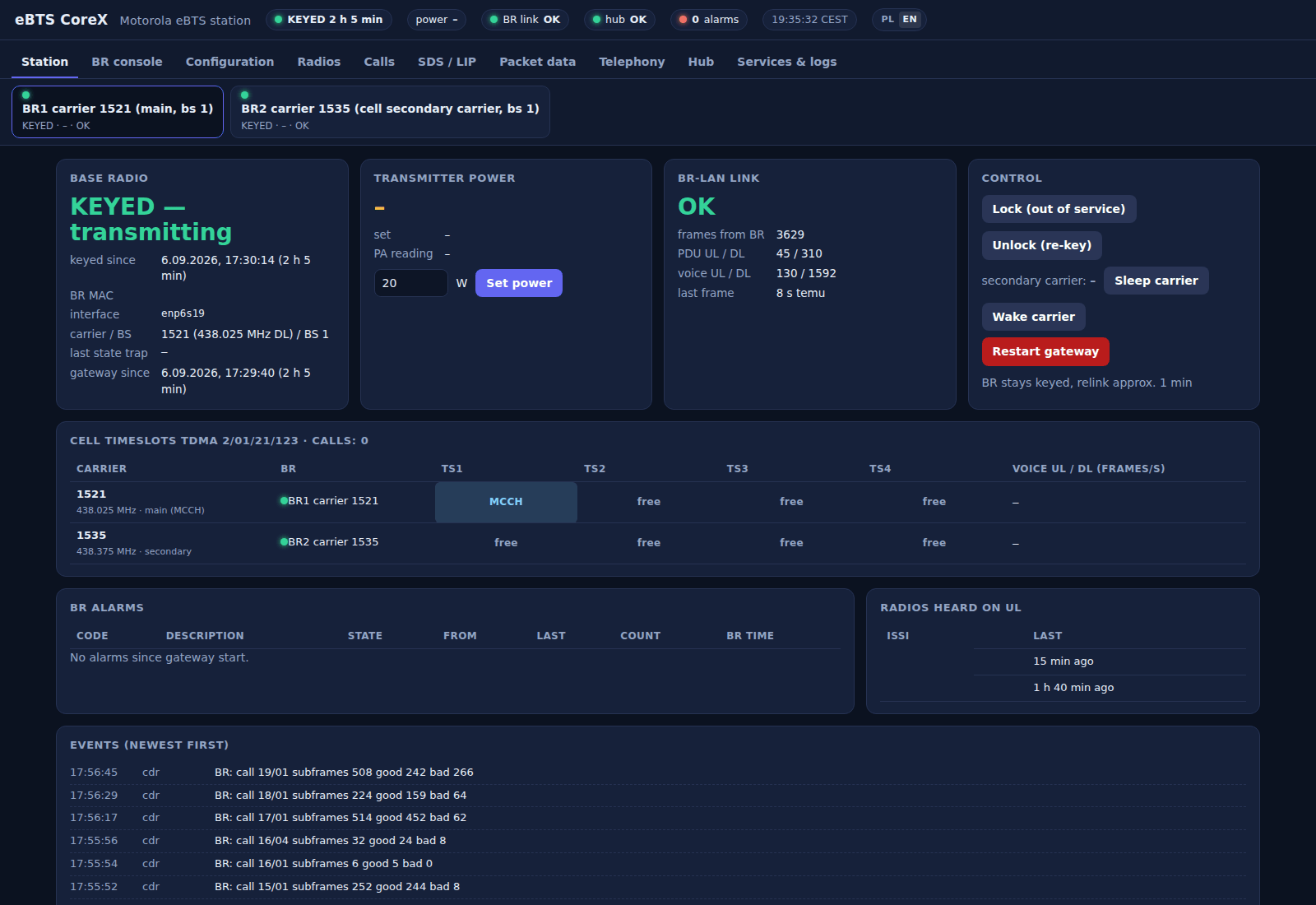
The Motorola EBTS, MBTS and MTS are professional TETRA base stations that do not transmit on their own — they need the Dimetra core network (the SwMI, Switching and Management Infrastructure), and without it they are transmitters with no brain. This project replaces that core with our own software and covers all three station families. The station’s BR (Base Radio) now works for us with the TSC (Site Controller) eliminated: our controller talks to the transmitter in its own protocol, brings it up, keys it and watches over it, and hands all the traffic — registrations, calls, messages, positions — to the same stack that drives TetraSpot. A professional station thus works as a full node of the TetraPoland network: no vendor core, no vendor servers, no dependence on anyone else’s infrastructure. The TSC-to-BR protocol was reconstructed by listening to the traffic on the station’s own link. Since 3 September 2026 our controller has been running a real community EBTS station live — the TSC is physically disconnected, and the station works in the TetraPoland network with the whole package that comes with it. On 5 September the controller ran both Base Radios of that station as one cell with two carriers. Since mid-September the whole setup has been running permanently on a small computer next to the station, with backup power.
What already works on a real station
BR configuration and keying just like the original TSC — channel parameters, TETRA time synchronisation, the full bring-up sequence
Adoption of a running BR after the TSC (Site Controller) is unplugged — no station restart
Two carriers in one cell — two Base Radios on the station’s shared LAN under one controller, the second as the cell’s secondary carrier with four traffic channels; both keyed within a minute and a half of a restart (checked on 5 September), and the secondary carrier can be put to sleep and woken from the panel
Radio registration and group attachment
Group calls — locally between radios on the station and with the whole TetraPoland network through the hub, with voice both ways; pressing PTT again during the call hang time and a clean channel release when the call ends
Individual calls, simplex and duplex — with talker change in simplex and simultaneous voice in both directions in duplex
SIP telephony gateway — a call from a radio to a number on the telephone network through a SIP PBX, with audio
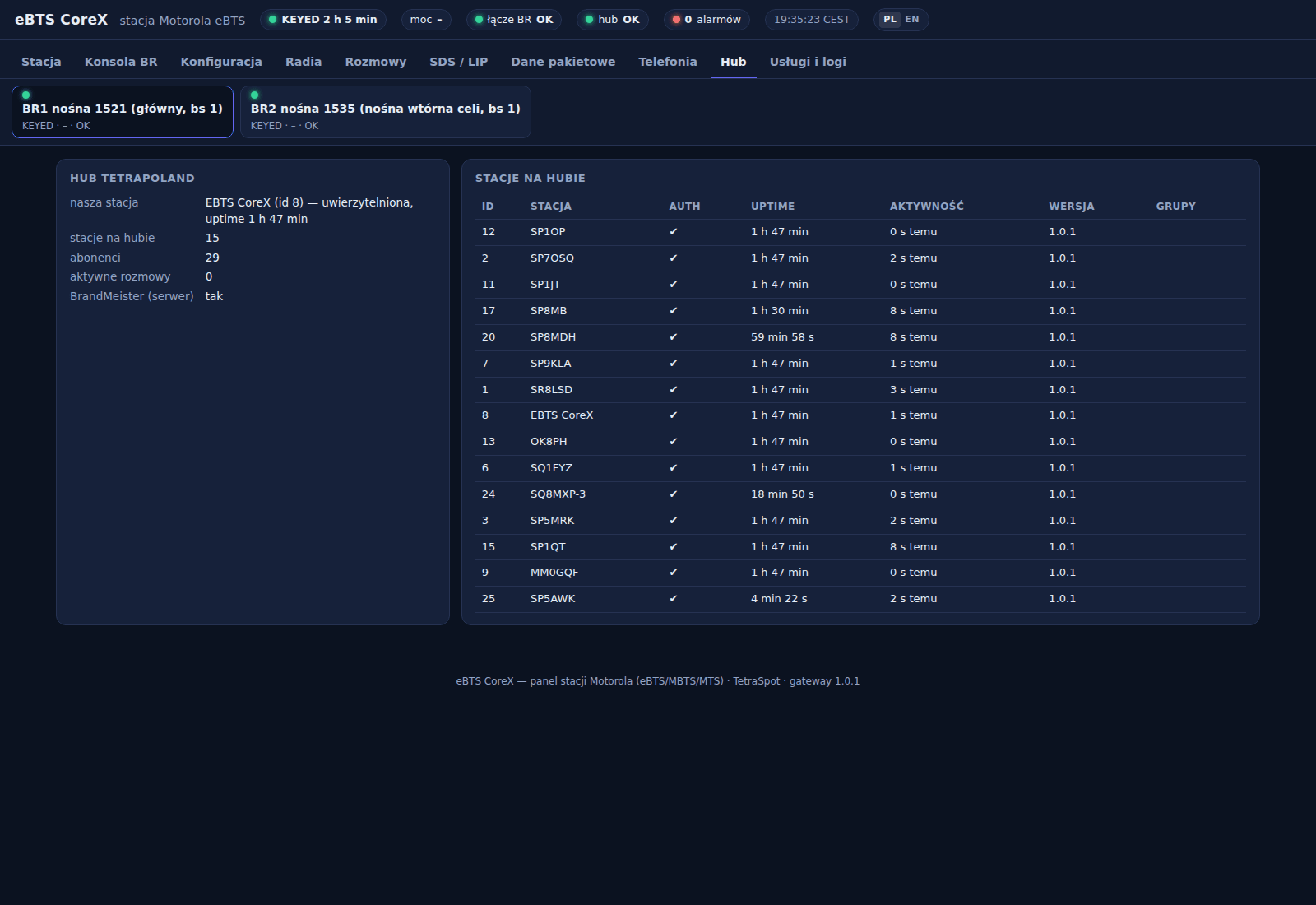
The station works in the TetraPoland network like any other node, with the whole package that comes with it — and with its own identity on the hub
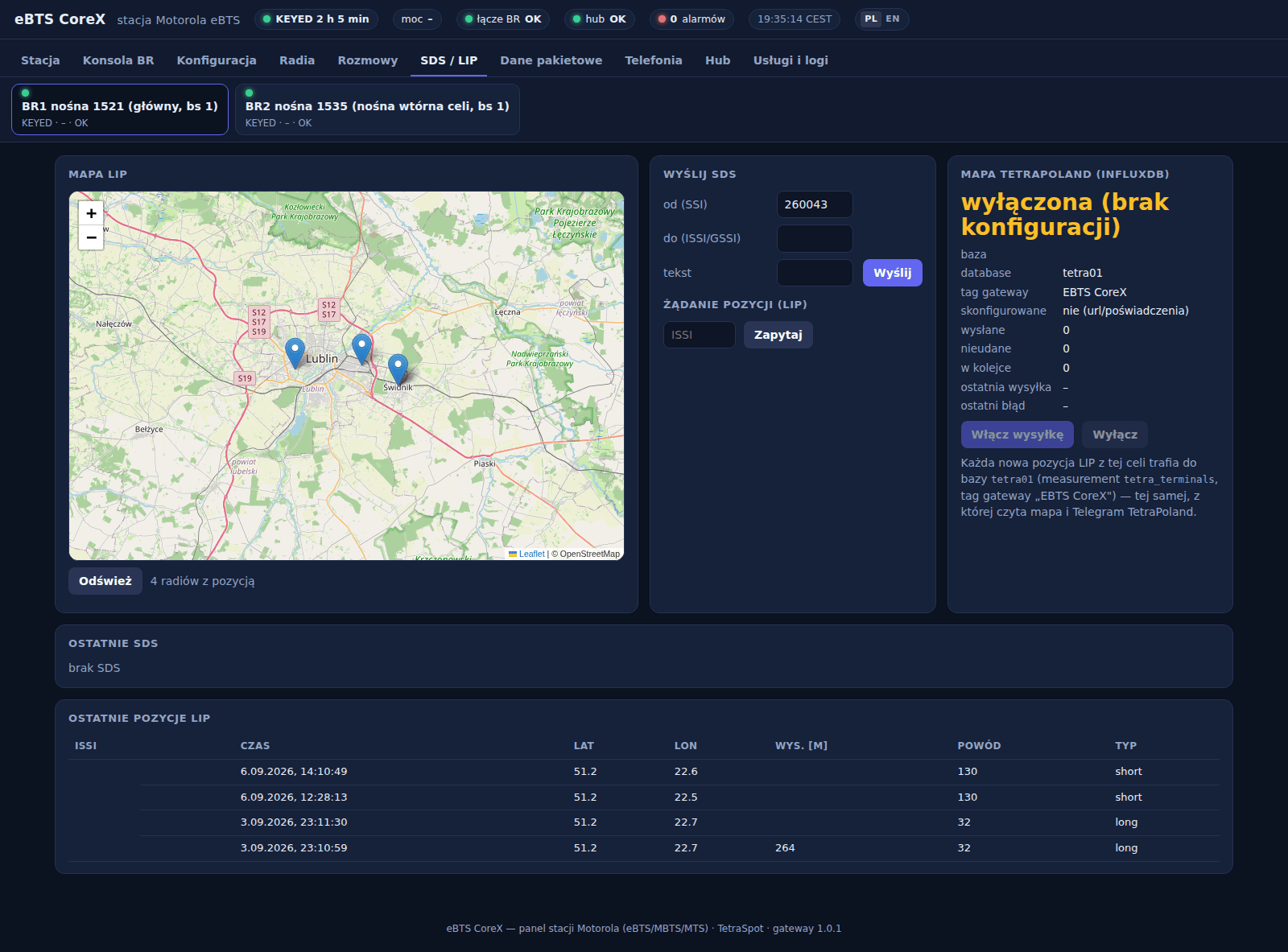
Radio GPS positions (LIP) — polled on request and shown on the map in the station panel
Presence probing as in the original Dimetra network — a radio is polled only after five minutes of silence, radios in an ongoing call are left alone, and once out of range a radio is deregistered instead of lingering in the register
Location Area, MCC and MNC set from the panel — the transmitter receives them exactly as it did from the original controller, confirmed by reading the configuration back from the BR itself
Transmitter event and alarm history stored on disk and shown in the panel, with the cause of every BR state change
TETRA network time with the right time zone — radios show local time (the original controller sent it an hour behind)
Automatic recovery after a fault — when the frequency reference is lost the station dekeys the transmitter itself, and once it returns it reconfigures and keys it again with no operator involved
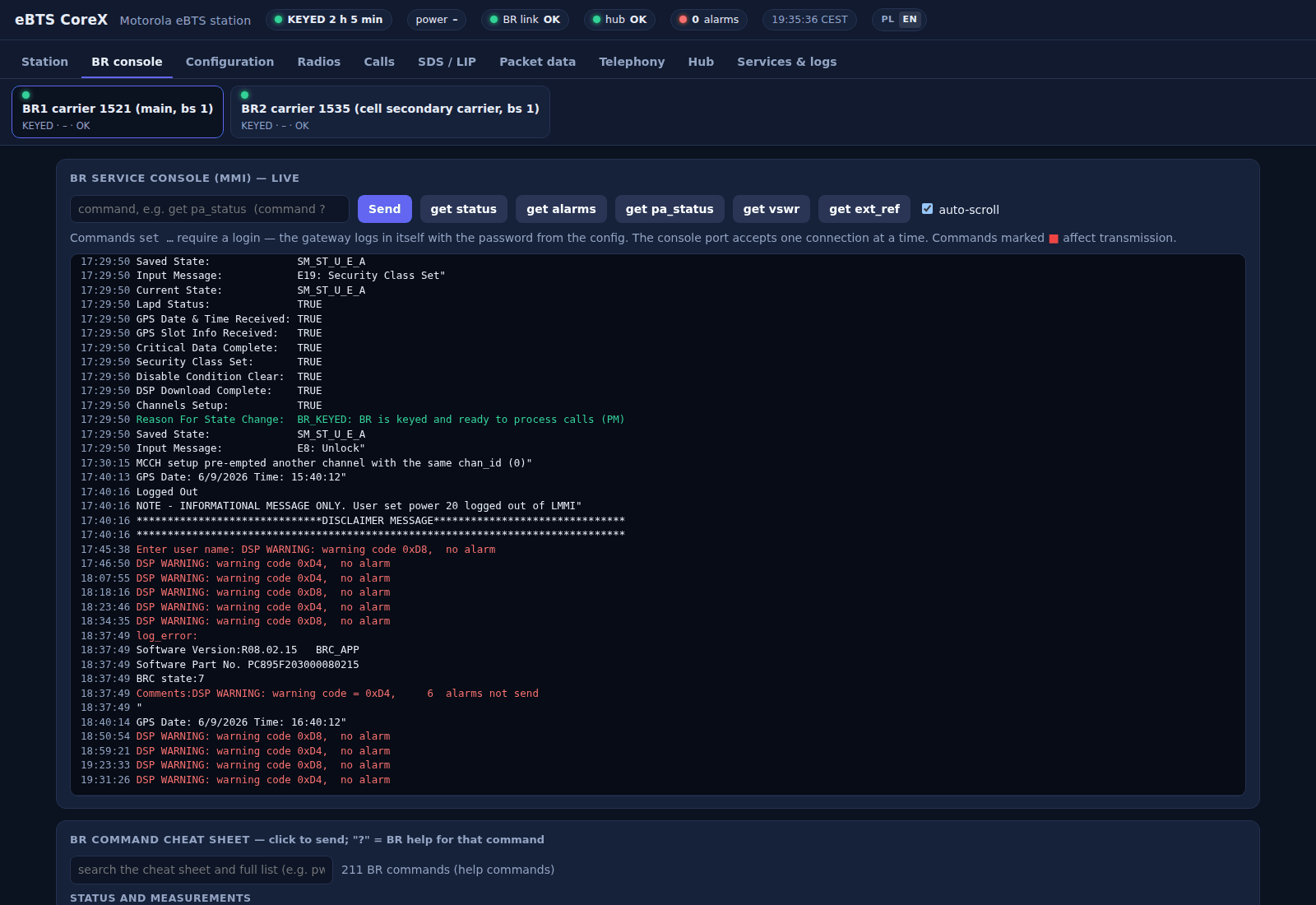
Live BR service console in the panel — over the network or a USB serial port, with a cheat sheet of over 200 commands described from the live transmitter, automatic power setting after keying and read-back of the real output power
Swapping the Base Radio for another unit without changing the configuration — the controller imposes frequencies and power; changing the station’s operating channel from the configuration file (a frequency change and return tested)
A dedicated station web panel (eBTS CoreX), in Polish and English — state of both transmitters and the cell timeslot grid, alarms and a record of every call from the BR, console, configuration from the browser, radios and whitelist, call log with callsigns, SDS/LIP map, packet data, telephony, hub and system services
Configured like an SDR station — one file in which the Motorola station’s transmitter is named instead of a radio front-end; each BR configured separately from the panel, with the network card and console port picked from a list
An installation package for other stations — an installer with a short questionnaire (system name, the station’s network card, credentials) sets up the whole controller on an ordinary Linux computer; shared with testers
Survives a controller restart — the transmitter stays keyed and the controller re-establishes the link within tens of seconds of starting
In progress
Calls on the secondary carrier — the second carrier was keyed and configured, but traffic only lands on it once all channels on the main carrier are busy; that case has not yet been forced on the air, and the second Base Radio is currently awaiting serviceUp to four Base Radios under one controller, with automatic adoption of a new transmitter plugged into the station LAN — ready in the controller, awaiting a trial with more transmittersThe reverse direction — an SDR station posing as a Base Radio towards an original Dimetra controller; the first stage matches recordings of a real transmitter byte for bytePacket data and the WAP portal — the radio activates a context and moves to the data channel, but keeping that channel alive on the BR side still needs to be reconstructed; work parkedTelephony — incoming calls from a phone to a radio not yet checked; a radio restart after a duplex call still to be explainedBrandMeister (groups 91+) — the station is connected to the BrandMeister network, voice traffic still to be confirmedPositions of radios on this station on the tetra-poland.pl map — switched on, awaiting the first reportTerminal authentication with a whitelist — service running, letting everyone through for nowPeriodic position reports from radios — need changes in their codeplug
The Motorola BR stays, the TSC goes — the whole “brain” of the station is ours. Above the gateway runs exactly the stack that serves the SDR station on a Raspberry Pi in TetraSpot — to it, the Motorola station is simply another kind of transmitter, and the second Base Radio another carrier of the same cell.
Proven on a real station
Since 3 September 2026 our controller has been running a community EBTS station with the TSC (Site Controller) eliminated — the BR (Base Radio) works for us, and on 5 September two of them at once — transmitters keyed at 20 W, radios registered, group calls local and through the TetraPoland hub with voice both ways, individual calls simplex and duplex, a call from a radio to a phone, LIP positions, automatic recovery after a reference fault, a Base Radio swapped for another unit. The project’s first stage (from February 2026) emulated the whole Dimetra core behind the station’s original controller — that experience made it possible to go one step further and replace the controller itself.
What you need
A Motorola EBTS, MBTS or MTS station with one or more Base Radios · an Ethernet hub with a BNC port · a 5 MHz reference with a 1 PPS signal injected · a Linux computer with two network ports — the station LAN runs at 10 Mb/s and the station connects over BNC, so a hub with such a port sits between it and the computer. The transmitter needs a 5 MHz frequency reference with a 1 PPS signal superimposed on it — without it it never reaches readiness, and when it is lost it dekeys itself. One network port of the computer lives on the station LAN, the other reaches the internet (TetraPoland hub, BrandMeister). The controller can run in a virtual machine, with the ready-made TetraSpot services alongside it. The transmitter’s boot files come from your own station.
🕸️
OSNOWA — an encrypted LoRa mesh network
Our own radio network protocol: range before speed, end-to-end encryption, no internet needed — by SP8MB
Pre-alphasince September 2026
OSNOWA is our own mesh network protocol on LoRa modules, working in the 869 MHz band with no radio licence and no outside infrastructure at all — no internet, no cellular network, no satellite. The order of goals is deliberate: range first, then security, speed last. The unit is a short message — text, status, position, alarm — carried by relays on high points across tens of kilometres per hop. The name comes from the Polish word for a geodetic control network: the set of reference points everything else is measured from. The protocol combines the best mechanisms of known mesh systems (Reticulum, MeshCore, Meshtastic, Barrage Relay) and adds its own: airtime treated as a budgeted resource, synchronous flooding as a cheap broadcast, and report aggregation. Content is encrypted only by the user’s device — the radio is just a modem and the relay knows no user keys, so losing one compromises nothing. It connects to the TETRA network (SDS, statuses, LIP positions), allows remote control of systems and carries telemetry over our own encrypted protocol, with apps and drivers for Windows, Android, iOS and Linux. The TETRA gateway has been checked with a real Motorola radio.
What already works on hardware
Black-layer modem on Heltec WiFi LoRa 32 boards (V2, V3, V4) — masks the header with the network key, authenticates every frame, suppresses duplicates and retransmits; it never knows the content
End-to-end encryption in the user’s device (X25519 + Ascon) — checked in over two thousand trials, with state saved before every transmission
Relaying through an intermediate node on three nodes — a broadcast passes through the relay right after reception, with no clock and no slots
OSNOWA–TETRA gateway over the radio’s PEI — text from OSNOWA reached a radio on the TETRA network, a status was delivered with network confirmation, and a message from the TETRA radio reached the OSNOWA user with a delivery report; checked on a Motorola MTP3250 with a second radio on the network
Position in OSNOWA encoded exactly like a TETRA short LIP report — no translation needed at the gateway
IP tunnel over LoRa — IPv4 and IPv6 ping with no loss, about 0.8 s round trip on the fast profile
Airtime matching the calculation to within 0.3 %, throughput of seven radio profiles measured in both directions, report aggregation cutting transmission 2.35 ×
The older SX1276 chip working with the SX1262 — boards of different generations in one network
Regulatory limits enforced in the device itself — an hourly airtime budget and conversion of power to ERP with a warning when the limit is exceeded
A measuring instrument in the same firmware: reception logger, test transmitter, band occupancy and airtime measurement, results in a format ready for coverage-map calibration
A windowed flasher — new devices and updates with no command line
System capabilities
Interface with the TETRA network — SDS messages, statuses and LIP positions pass between OSNOWA and TETRA radios in both directions
Remote control of systems — commands to devices and installations at distant sites over the radio network
Telemetry over our own encrypted protocol — measurements and device states with no internet and no cellular network
Apps and drivers for Windows, Android, iOS and Linux
In progress
Field range tests — waiting for transmit power and noise floor measured with an analyzerSource routing and message storage — after real range has been measuredGroup keys and periodic session key renewalSynchronous flooding on six nodesNetwork view on the ATAK mapLarger datagrams in the IP tunnel (fragment retransmission)
How it is built
  user device                       OSNOWA modem           relay                   OSNOWA modem
  (phone, computer)                 (black layer)          (mast, rooftop)         + TETRA gateway
  ┌──────────────────┐   cable   ┌────────────────┐ LoRa ┌────────────────┐ LoRa ┌────────────────┐  PEI  ┌──────────────┐
  │ keys, content,   │ ────────► │ network key,   │ ~~~~ │ no user keys,  │ ~~~~ │ network key    │ ────► │ TETRA radio  │
  │ end-to-end       │  or BT    │ masked header, │      │ synchronous    │      │                │       │ (Motorola)   │
  │ encryption       │           │ airtime budget │      │ flooding       │      │                │       │              │
  └──────────────────┘           └────────────────┘      └────────────────┘      └────────────────┘       └──────────────┘
         plaintext exists only here       the rest of the network sees ciphertext only
Keys and plaintext exist only in the user’s device. Modems and relays know only the network key, which hides headers from outside receivers — a relay itself can be left unattended on a mast.
What it runs on
Heltec WiFi LoRa 32 V2 / V3 / V4 · 869.4–869.65 MHz band (up to 500 mW ERP, 10 % duty cycle) or 869.7–870 MHz (5 mW, no limit) — off-the-shelf boards, no custom-made hardware. The link budget on the long-range profile is about 167 dB, so range is set by terrain and antenna height, not power. The real constraint is airtime shared by every node that can hear each other — which is why every protocol decision is accounted for against it.
📻
TLA — Tetra Light Analyzer
author: SP8MB
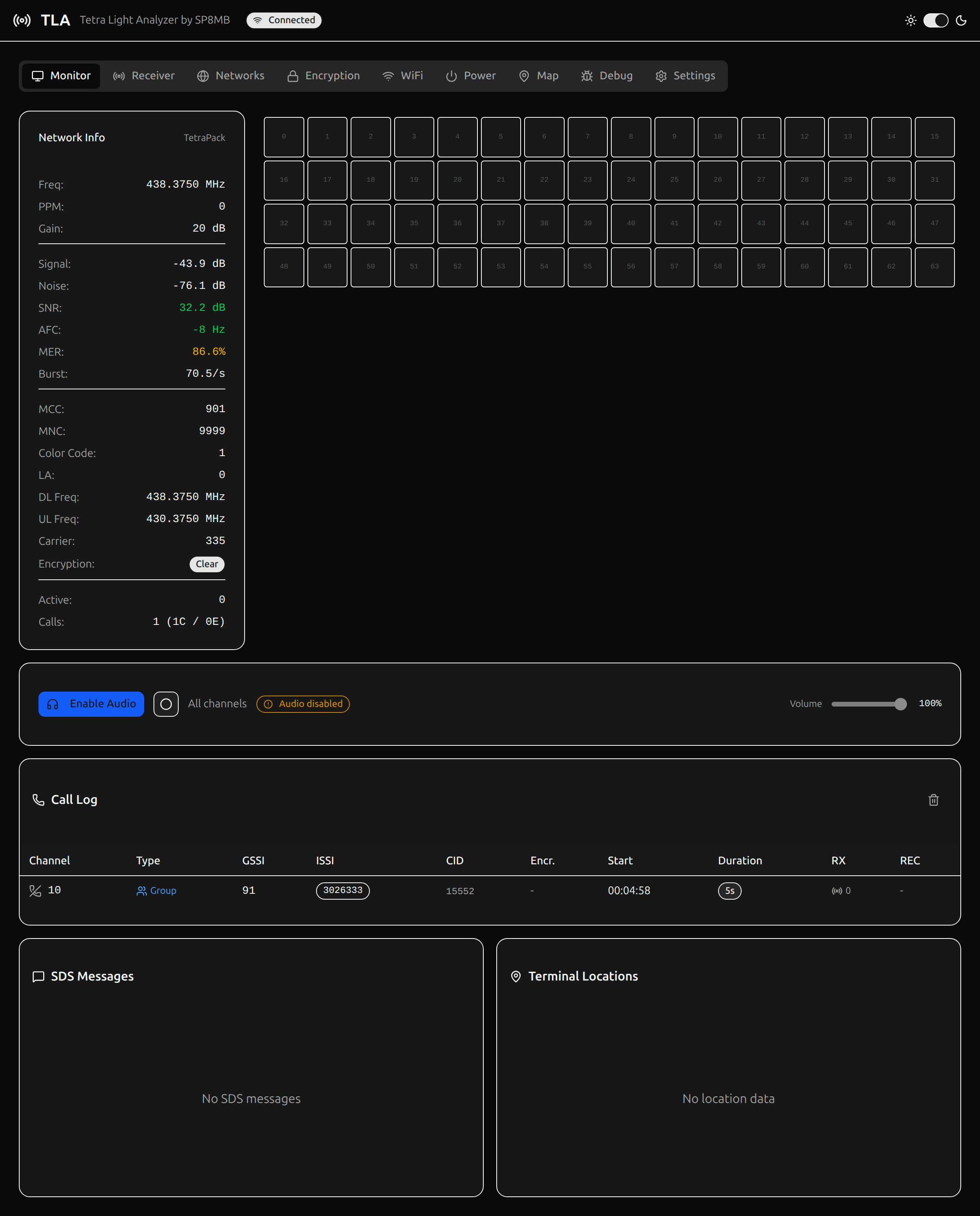
Web-based TETRA network analyzer on Raspberry Pi. Real-time monitoring of 64 channels with voice playback, call recording, spectrum analysis, SDS decoding and terminal location tracking — all from a browser.
Features
Monitoring
Real-time monitoring of 64 TETRA channels
GSSI/ISSI identifier display
Call type recognition (group, individual, PSTN)
Encryption detection (none / TEA1)
Color-coded channel activity grid
Audio
Live call playback (our own ACELP implementation)
Automatic call recording to MP3
Channel selection and muting
Download and manage recordings
Spectrum & signal
FFT spectrum with waterfall visualization
DQPSK constellation diagram
Signal/noise/SNR monitoring
Quality metrics: MER, burst errors, carrier number
AFC tracking (automatic frequency correction)
Data
SDS message decoding
Terminal location tracking via LIP protocol
Call registry with full session history
Network statistics (call count, active terminals)
Export reports to PDF
Network
MCC/MNC identification with operator name
Known networks database with quick tuning
Neighbor frequency detection
Auto-tune to NETINFO frequencies
Auto PPM correction from AFC value
System
Responsive web UI (desktop and mobile)
Bilingual UI (Polish / English)
Light / dark theme
HTTPS with SSL certificate
Optional password protection
Support for multiple SDR receivers (RTL-SDR, HackRF, Airspy, SDRplay, LimeSDR, USRP)
Android app connecting to the TetraPoland hub over a fast, resilient QUIC link. It works as a software TETRA terminal — users get full radio functionality (group and individual calls, SDS, talkgroup scanning) on a regular phone with a cellular or Wi-Fi connection. Compatible with hardware PTT buttons, wireless Bluetooth LE buttons and headsets (SCO). It supports private calls between users, sign-in with your BrandMeister network credentials, and GPS positions reported to the tetra-poland.pl map. Since 1.8.3 it also connects straight to amateur digital networks — BrandMeister, DMR Homebrew, YSF, FCS, M17 and NXDN — with no hub in between, while TETRA works exactly as before.
Features
Group PTT calls (RX/TX) with floor control
Individual calls (half/full-duplex)
Sign in with your BrandMeister network credentials
SDS messages — individual and group, with delivery reports and quick replies
Talkgroup scanning with hold, priority and DSP presets
GPS position reporting to the tetra-poland.pl map and GPX track logging
Bluetooth LE PTT buttons (PTT-Z01, AnyTone, HM-10)
Hardware PTT and Bluetooth SCO headset
Own ACELP codec implementation per the ETSI specification
QUIC transport (Brew-over-QUIC) — fast resume after a network change
YSF and FCS (System Fusion) — rooms picked exactly like talkgroups
M17 — connection with the callsign in every frame
NXDN — connection and traffic view
Groups 1–90 always stay; above them the chosen network decides
Network from the menu, server from a searchable catalogue
A direct link to the network, with no TetraPoland hub in between
What has not been tested yet
Two things said plainly — transmit on YSF, FCS and M17 builds correct frames, but nobody has tried it on the air yet: the first transmission will also be the first test. NXDN so far only connects and shows traffic, without sound — over a quarter of an hour listening on six reflectors nobody spoke, so there was nothing to take apart.
In development
Companion Wear OS watch app — PTT and favourite talkgroups from the wrist, optional audio through the watch (hardware testing in progress)Responsive layout (beta) — fits small displays, the touch PoC radios among them; switched on in Settings, meant to replace the current one
Software TETRA terminal for iPhone and iPad — PTT-over-Cellular
TestFlight
The same TetraPoland network, now on iPhone and iPad. The app connects to the TetraPoland hub over the same fast QUIC link as the Android version and turns the phone into a software TETRA terminal — group PTT calls and private calls (simplex and full-duplex) over mobile data or Wi-Fi. A full-duplex private call behaves like a regular iPhone call: it shows on the lock screen and in the system (CallKit). Only an identity verified by BrandMeister (a verified DMR ID) gets on the network — no more anonymous login. Distributed through TestFlight.
Features
Group PTT calls — transmit and receive
Private calls — simplex and full-duplex
Full-duplex calls integrated with iOS (CallKit) — on the lock screen, like a regular phone
Automatic hang-up of a simplex call after a short idle
Call setup tones (ringback)
Talkgroup scanning with answering on the scanned group
PTT beep and an optional roger beep audible to the other side
The tetra-poland.pl map built into the app
Receive-quality bars with a threshold legend
Reception mixes with music and podcasts instead of pausing them
The radio survives a phone call — reception comes back on its own, no re-login
Sign in only with a BrandMeister-verified DMR ID
Optional GPS position reporting to the tetra-poland.pl map
ACELP codec core shared with the Android version, per the ETSI specification
QUIC / WSS transport to the TetraPoland hub
Digital networks alongside TETRA (since 1.1.4)
BrandMeister — straight to a master, no hub in between; a green or red dot shows which ones answer
Groups 1–90 always stay; above them your starred rooms from the chosen network
Every network with its own searchable catalogue
What you cannot hear yet
M17 and NXDN connect and show traffic, but stay silent — M17 needs the Codec2 vocoder, which we have not built for iOS yet; on NXDN we never caught a single transmission, so there was no frame to take apart. The app says so at each network, so the silence does not read as a fault.
In development
Wireless Bluetooth LE PTT button (PTT-Z01, AnyTone, HM-10) — hardware testing in progressPush notifications — waking the app for an incoming call while it is closedVoice on M17 (the Codec2 vocoder on iOS) and on NXDNApp Store release (currently available via TestFlight)
How to install
iPhone / iPad · iOS 16+ · TestFlight — install the app through TestFlight (link and invite code on the “Download” page). Current version 1.1.4.
A TETRA terminal on a PoC radio — driven from the keypad alone
Early release
A separate app for PoC radios with no touchscreen — the Hytera P50 with its 240×320 display among them. Everything is done from the keys: the D-pad, the PTT trigger, the talkgroup knob and the Menu and Back keys. It shares its core with TetraPoland for phones — the same network, the same talkgroups, the same vocoder — but has its own keypad-driven interface and its own version numbering. Since 0.1.6 the radio also works on amateur digital networks, and the hardware PTT transmits to whichever network was chosen in the menu.
Features
Everything driven without touch — D-pad, PTT trigger, talkgroup knob, Menu and Back
Sign in with a DMR ID and a BrandMeister SELF CARE password
Group and full-duplex calls, contacts, call log
Text messages with a phone-style keypad — digits in a grid, CLR and OK where the star and hash keys are
Scanning of favourite talkgroups — only a group visible on the scan screen can be scanned
Alarm key with separate actions for a short press and a long press — scanning and an alarm message to a chosen contact by default
A “Group” tile that steps to the next favourite talkgroup — it replaces the knob when the radio firmware locks it
All of it chosen with the arrows and the centre key, no touchscreen needed
Groups 1–90 always stay; above them the chosen network’s rooms take over
The hardware PTT follows the chosen network — on this radio it is the only way to transmit
What has not been tested yet
The same as in the touch version — transmit on YSF, FCS and M17 has not been tried on the air, and NXDN so far only connects and shows traffic, without sound.
What it runs on
Hytera P50 · 240×320 display · 32-bit ARM — PoC radios use an armeabi-v7a processor, so they get their own download. The radio firmware will not let the app update itself — a new version is installed exactly like the first one.
Plugin for ATAK (Android Team Awareness Kit) integrating the tactical map with TETRA radio. Terminal positions (LIP) appear on the ATAK map as CoT (Cursor on Target), SDS messages show as alerts, and PTT allows transmission without leaving the map. Radio connection via USB/Serial, Bluetooth SPP or TCP gateway.
Features
SDS — short text messages (SDS-1 / SDS-2)
LIP — automatic position reporting on CoT map
Status messages — predefined and custom
PTT — transmit button from the tactical map
Group and individual calls
Team positions visible on the ATAK map
Floating PTT overlay on map (draggable)
RX / TX, signal and radio battery indicators
Talkgroup switching from radio keypad (+MCTGS)
Connection: USB/Serial, Bluetooth SPP or TCP gateway
Periodic position reporting (30 s moving / 15 min static)
Auto-reconnect and background operation (foreground service)
🔐
TSIM — TETRA SIM Applet
JavaCard SIM applet for TETRA terminals
JavaCard applet implementing the TETRA identity module (TIM/TSIM) per ETSI TS 100 812-2. Provides the full TAA1 authentication chain (HURDLE + TA11/TA12/TA21/TA22/TB4), OTAR key management (TA32/TA52/TA71/TA82/TA92) and the DF_TETRA file structure with required EFs (ITSI, SPN, forbidden networks, SCK/CCK/GCK addresses). Operates via UICC/APDU interface — can replace the original card in any TETRA terminal.
ETSI TS 100 812-2 V2.4.1 — TSIM ApplicationETSI EN 300 812-3 V2.3.1 — IC card TSIMETSI EN 300 392-7 — Security (TAA1, TEA1)
🎛
TETRA Remote Head
Remote TETRA radio control panel via PEI
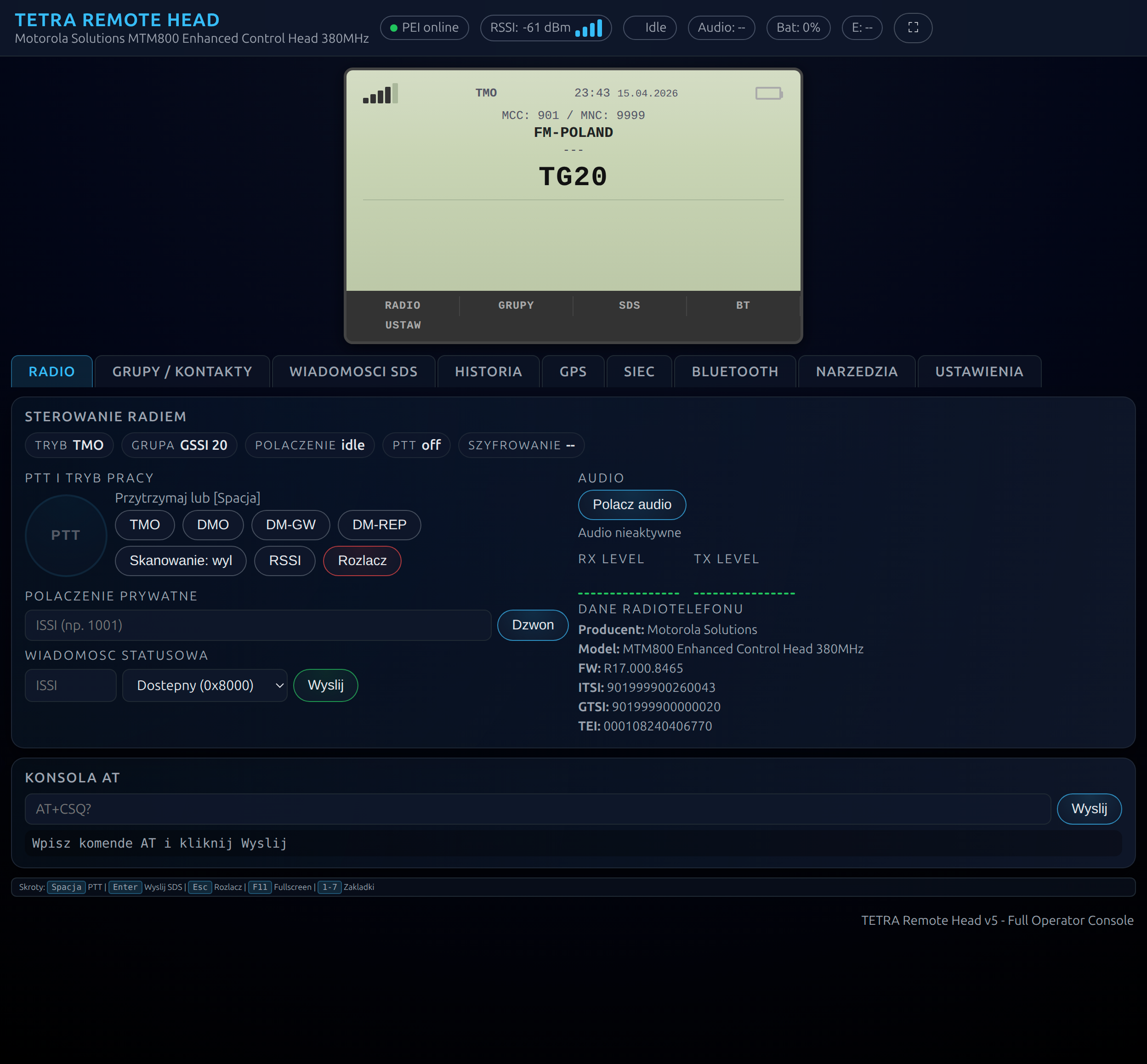
Web control panel for a Motorola TETRA radio driven by AT commands over the PEI (RS232) interface. The backend exposes a REST API, SSE event stream and full-duplex audio over WebRTC — so any browser can operate the radio like a physical control head: group and individual calls, SDS, talkgroup switching, scanning, GPS, network status. It can also run as a full remote operator console: it captures the GPS positions of other radios by polling Remote SDS and visualizes them on a map. Designed for vehicle mounting (e.g. BMW R1250RT) with the radio in the case and the panel on a phone. A newer variant integrates a motorcycle-helmet intercom (Cardo) and a wireless PTT button through an ESP32 bridge.
Features
Full radio control via AT/PEI
WebRTC full-duplex audio (RX/TX) with low latency
PTT from the browser (click, key, touchscreen)
Wireless Bluetooth LE PTT button (ELET-PTT603E34)
Motorcycle-helmet bridge: ESP32 + Cardo intercom (HFP) — audio and PTT over Bluetooth
Group and individual calls, SDS
Talkgroup selection and scanning
GPS, RSSI, battery, network status, alarm/TXI
Captures GPS positions of other radios by polling Remote SDS
Live map visualization of terminal positions
Runs as a full remote operator console
Remotely clear an alarm and control many functions of remote terminals (requires the option programmed in CPS)
PEI multiplexer (pei_mux) — shared port for svxlink + remotehead
Radio watchdog — automatic recovery of the radio link
HTTPS + optional authentication
systemd service, autostart
Architecture
TETRA radio (Motorola MTM/MTP)
       |
   RS232 / PEI (AT, 9600 bps)
       |
       v
   /dev/ttyS2
       |
   pei_mux  (multiplexer: PTY symlinks, AT serialization, URC broadcast)
       |          |
       v          v
  svxlink     tetra_remote_head  (web server)
              REST :443  SSE :443  WebRTC (audio)
                     |
                ALSA: radio_capture / radio_playback
                     |
              Browser (PWA, control head)
Target deployment: BMW R1250RT motorcycle — radio in the case, phone on the handlebar as the panel.
Tested radios
Motorola MTH800 · MTP700 · MTP850 · CEP400 · MTP35xx · MXP600 · all MTM/MXM · Hytera PTC760 — controlled over the PEI (AT) interface.
🎧
OWRX Mobile (Android)
Native OpenWebRX+ client for Android — by SP8MB
Beta
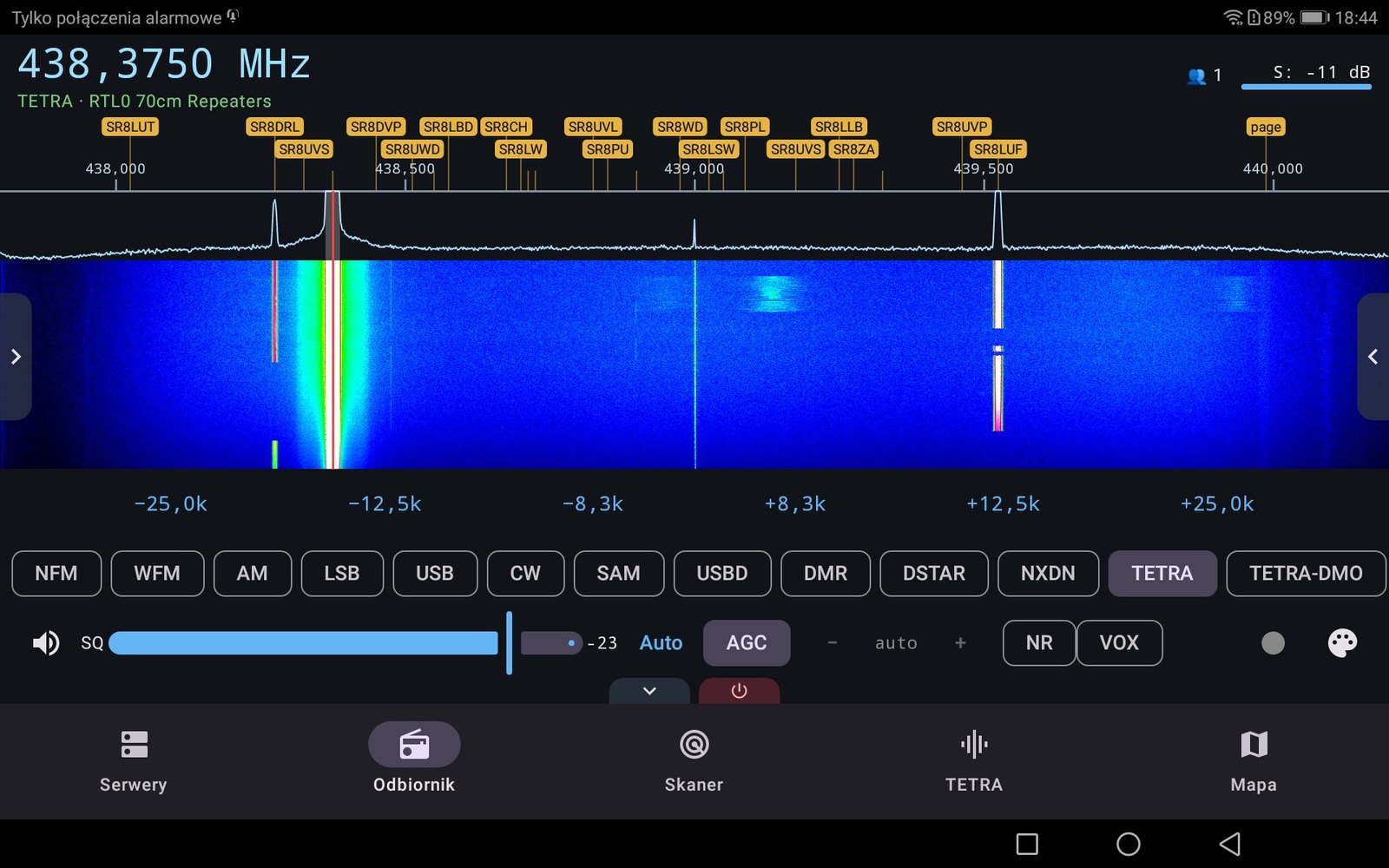
Native Android client for OpenWebRX+ receivers (luarvique fork). It lets you listen to your own SDR servers in the field — with background audio, a band scanner, a TETRA monitor and an APRS map. It exists because the browser falls short in the field on Android: audio dies with the screen off and an LTE drop needs a manual refresh. A pure client for your own servers (supports nginx basic auth) — it neither contains nor bypasses any encryption.
Features
Receiver
Waterfall and spectrum with a frequency scale (pinch-zoom, pan, tap to tune)
Digital frequency readout — enter MHz with auto-jump to the covering profile
Mute and software volume, squelch with Auto mode
AGC / manual device gain, noise reduction (NR)
Band bookmarks with tags above the scale
Background audio
Background playback with a media notification and wake lock
Silence watchdog (30 s) and automatic reconnection
Resumes last state after an LTE drop (frequency/mode/squelch)
Full session shutdown with one button
Scanner and recording
Three modes: full band, range (from–to), bookmark scan
Carrier detection from FFT, manual or Auto threshold, 8.33 / 12.5 / 25 kHz raster
Blacklist, hit history, beep and vibration on a catch
Recording to .m4a (AAC) and VOX mode (auto-record each transmission)
TETRA and map
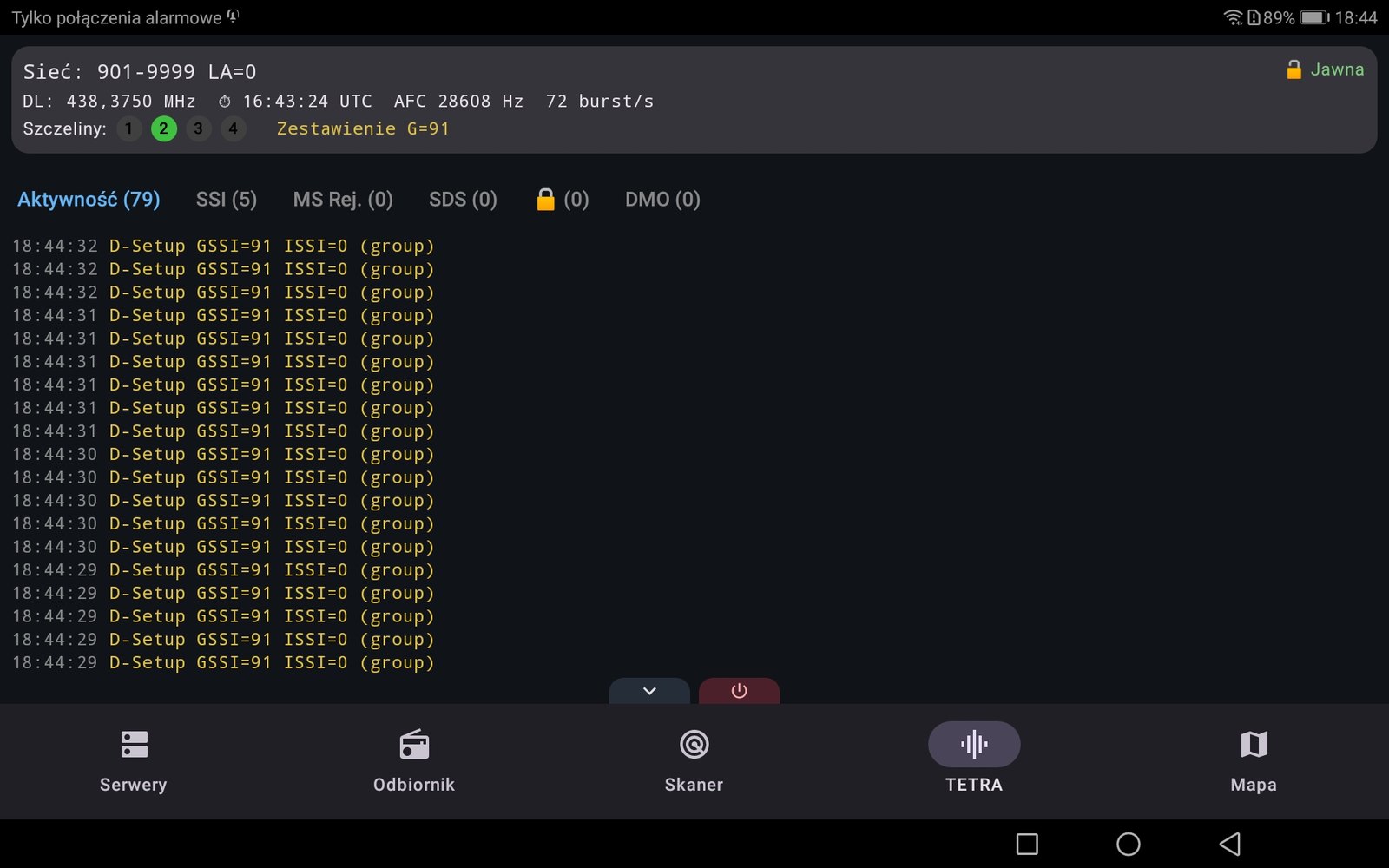
TETRA monitor: network (MCC/MNC/LA, ETSI time, encryption), timeslots, neighbors
Active SSIs by category (Real / Address / ESI), MS registrations, SDS
OSM map with APRS/AIS icons — including locally decoded frames
Aircraft rotated by heading (ADSB/VDL2/HFDL), Maidenhead locators
Administration
Manage the OWRX server from the panel (device list, gain, profiles)
Connects to your own OpenWebRX+ servers (nginx basic auth)
Polish-language interface
🌊
OpenWebRX+ TETRA Plugin
TETRA decoder plugin for OpenWebRX+ — by SP8MB
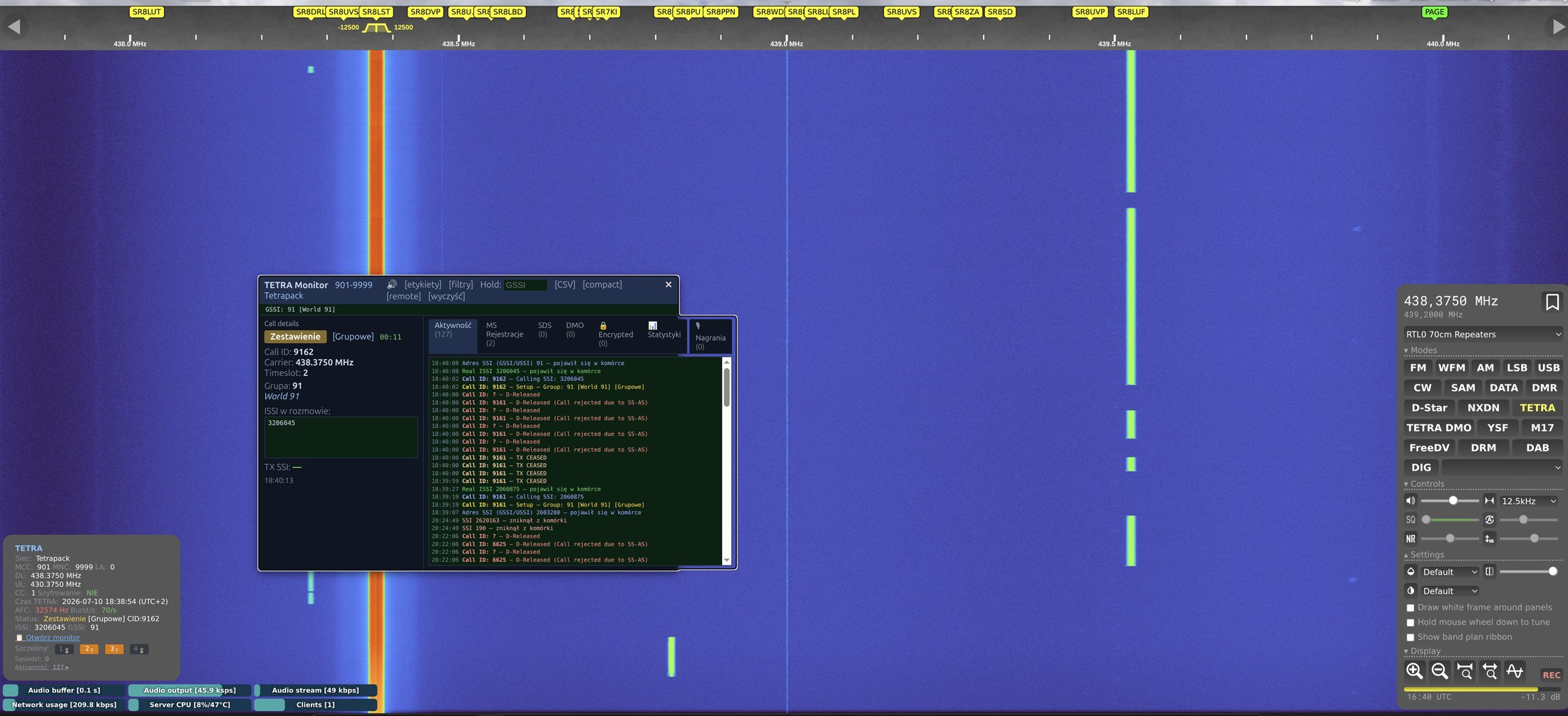
A plugin that adds a TETRA mode to OpenWebRX+: π/4-DQPSK demodulation, L1/L2/L3 layer decoding, ACELP voice playback and a dedicated web panel with network, call and terminal information — all right inside the OpenWebRX+ UI.
GSSI / ISSI with real-ISSI vs ESI-alias distinction
Timeslot state (Traffic / Control / Common-Ctrl / Reserved / Unalloc) with TTL
Neighbor cell list (cell_id, carrier, DL freq, load)
Active SSIs and MS registration events (LU Accept/Reject, attach/detach, auth)
SDS messages with protocol and delivery-status decoding
Floating event window with filters, G/SSI label editor, CSV export, remote and compact modes
🔎
TETRA Air Trace
TETRA signaling decoder over the radio PEI — by SP8MB
A tool for capturing and analyzing TETRA air-interface signaling over the PEI (Peripheral Equipment Interface) of Motorola radios (MTM800 / MTP850). It connects to the radio over serial or USB, enables trace mode and decodes frames live — calls, registrations, SDS, GPS, SYSINFO. Available as a Windows app, an Android app and a desktop tool.
Motorola MTH800 · MTP700 · MTP850 · CEP400 · MTP35xx · MXP600 · all MTM/MXM · Hytera PTC760 — connected over PEI (ESC P … ESC S), 115200 8N1, serial or USB OTG.
Platforms
Windows appAndroid appDesktop tool
📈
Spectrum & EMC Analyzer
Service spectrum analyzer with a TETRA decoder — by SP8MB
Pre-alpha
A software radio spectrum analyzer with a web interface that replaces several separate boxes on the service bench. It does three things at once: shows a live spectrum with automatic signal detection and tracking, runs lab-grade measurements (channel power, occupied bandwidth, adjacent-channel power, harmonics) and performs electromagnetic-compatibility (EMC) testing against CISPR/EN55032 profiles — from prescan to a quasi-peak report. In live traffic it recognizes and decodes emissions, including TETRA (network TMO and direct-mode DMO) with voice playback, as well as DMR, P25, M17, YSF and D-STAR. It works with a low-cost SDR receiver or drives a Rigol lab analyzer, and runs in a simulation mode with no hardware at all.
Features
Spectrum & signals
Live spectrum with a waterfall
Automatic signal detection (percentile baseline + OS-CFAR)
Tracking of emissions appearing and disappearing (NEW / GONE)
Emission-type recognition and demodulation
Measurements
Markers, channel power, occupied bandwidth (OBW)
Adjacent-channel power (ACP), carrier-to-noise (C/N)
Harmonics and third-order intercept (TOI)
EMC
CISPR32 / EN55032 profiles
PRESCAN → peak list → quasi-peak measurement → report
Hardware quasi-peak detector
HTML / SVG report
Decoders
TETRA TMO and DMO — with voice playback (our own ACELP codec implementation per the ETSI specification)
DMR, P25, M17, YSF and D-STAR
AES-256 / RC4 decryption from a key store
Network, call and identifier view
Hardware
Low-cost SDR receivers (RTL-SDR, PlutoSDR)
Rigol DSA815-TG lab analyzer (SCPI control)
Simulation mode — works with no hardware
Validated on hardware
Spectrum with anomaly detection and full Rigol control (EMC and measurements) on a real analyzer — and TETRA decoding confirmed on a live 440 MHz signal, with voice recovered from a captured group call.